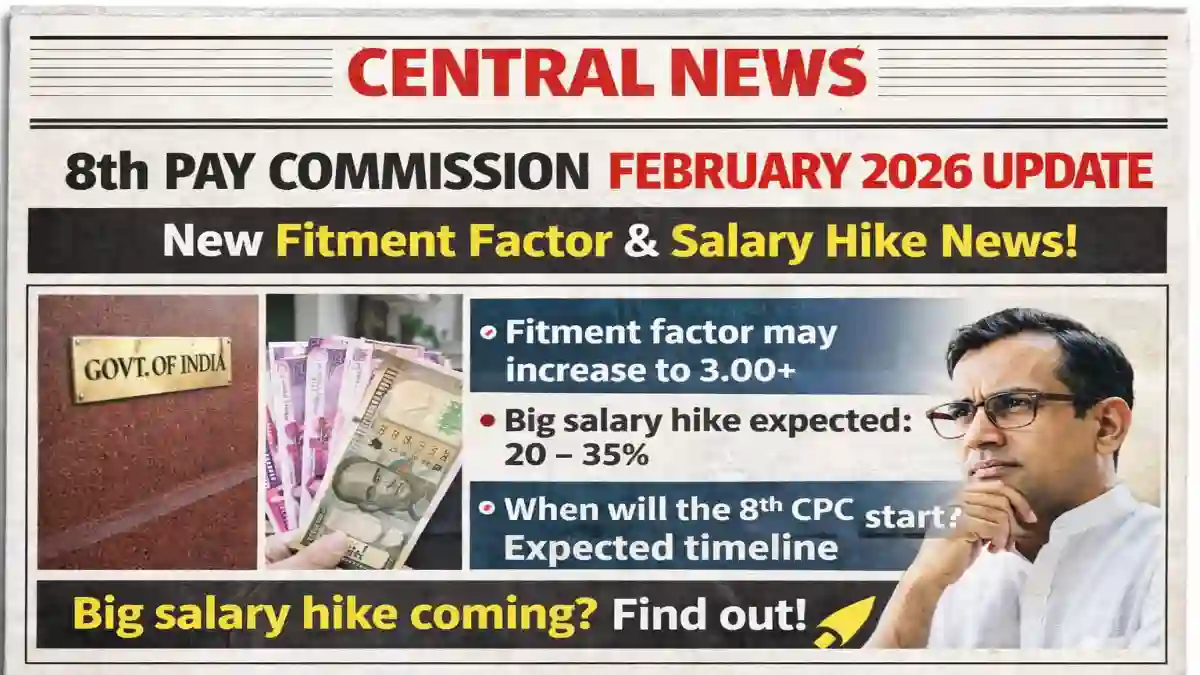
The 8th Pay Commission has once again become a hot topic in February 2026. Central government employees and pensioners across India are closely tracking every possible development related to salary revision. With the 7th Pay Commission having completed nearly a decade, expectations are rising that the government may soon move toward forming the next commission.
Although there has been no official announcement yet, discussions in policy circles and employee unions have fueled speculation about what could come next.
Why the 8th Pay Commission Matters
A Pay Commission is typically constituted every 10 years to review the pay structure, allowances, and pensions of central government employees. The 7th Pay Commission was implemented in January 2016. Based on the traditional cycle, 2026–27 is considered a likely period for the formation of the 8th Pay Commission.

Any revision under the new commission would impact millions of serving employees and retired pensioners. Even a modest change in the fitment factor can significantly increase take-home salary and pension benefits.
Fitment Factor in Focus
The biggest discussion point in February 2026 is the expected revision in the fitment factor. Under the 7th Pay Commission, the fitment factor was set at 2.57. This factor determines how much the basic salary increases when a new pay structure is introduced.

Employee unions are reportedly pushing for a fitment factor of 3.00 or more. If approved, this could substantially increase the minimum basic pay and raise salary levels across all pay bands. However, any final decision will depend on the government’s fiscal position and economic conditions.
Expected Salary Hike Percentage
While no official figures have been released, estimates suggest that the overall salary revision under the 8th Pay Commission could range between 20% and 35%. The final recommendation will likely consider inflation trends, dearness allowance (DA) adjustments, and long-term budgetary sustainability.

If implemented effectively, the 8th Pay Commission could reshape the salary structure for central government employees starting from 2027 or 2028.
Impact on Pensioners
Pensioners are also closely watching developments. Pension revisions are usually linked to updated pay matrices. If the fitment factor increases, pensions would automatically see a corresponding rise. This makes the 8th Pay Commission equally significant for retired government staff.

Many pensioner associations are urging the government to ensure timely formation of the commission to avoid delays in benefit distribution.
Possible Timeline for Implementation
As of February 2026, there has been no formal notification regarding the constitution of the 8th Pay Commission. However, experts believe the process could begin by late 2026 or early 2027.

Once constituted, a Pay Commission typically takes 12 to 18 months to submit its recommendations. After that, the government reviews and approves the proposals before implementation. If this timeline is followed, revised salaries could come into effect around 2027 or 2028.
Government’s Balancing Act
The government faces the challenge of balancing employee expectations with fiscal responsibility. A large salary hike increases government expenditure significantly. Therefore, economic growth, tax revenue, and inflation levels will play key roles in determining the final outcome.
What Employees Should Watch Next
For now, February 2026 remains a phase of anticipation rather than confirmation. Employees should rely only on official notifications and avoid unverified claims circulating online.
The 8th Pay Commission Update February 2026 has certainly raised hopes of a substantial salary revision. However, the real clarity will come only when the government formally announces the formation of the commission and outlines its scope. Until then, all projections remain speculative but closely watched.